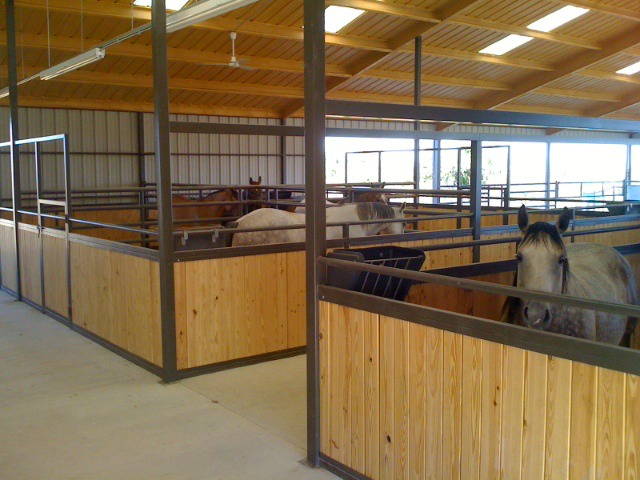
The door to a horse barn has a big impact on both the safety and function of the building. It is important to design doors that open easily and are safe for horses to use.
Stall doors that swing out into a wide aisle are preferred by many equine enthusiasts. Swinging doors may require a grilled top section to prevent jumping and offer options for opening them at either half or full height.
Sliding
Nothing takes a horse lover’s breath away like a long sweep of stall doors that open out into spacious barn aisles full of happy horses poking their heads out to socialize. When it comes to building a custom horse barn & portable horse stalls, there are seemingly hundreds of tiny details that need to be carefully planned to ensure a safe and comfortable environment for the animals. Choosing the right door is one of those small decisions that can have a large impact on daily life at the stables.
Sliding doors are an excellent option for stall doors because they don’t intrude on the barn aisle and make it easier to lead or cross-tie horses. However, sliding doors must be latched tightly so that horses cannot push through the stall or out of a stall when the door is left half-open.
The best sliding barn doors are made from hardwood, such as ash, rather than softwood. This is because hardwood is harder and denser than softwood, which allows it to stand up to the rigors of use by horses. Additionally, a hardwood door is more durable than a wooden door that is painted or varnished.
It is also important to keep in mind that a horse can easily grab onto the bolt that holds a sliding door closed, which could result in the bolt being pulled and caught on expensive horse blankets or sheets. To prevent this, it is a good idea to install a door with a hardware system that is spring-loaded and curved at the end of the bolt, making it difficult for a horse to catch on.
Hinged
While sliding doors may be the most popular stall door style for new horse barns, hinged doors can also be used. A hinged stall door provides an open appearance, allowing for ample natural light and ventilation in the stall. However, a hinged door needs to be latched shut when it’s opened and can potentially injure a horse or human if it isn’t properly secured.
Another disadvantage to a hinged door is that it can increase handling and steps when leading a horse out of its stall. This can be difficult for fresh or spooky horses on their way to turnout or other activities.
In the case of a center aisle barn, hinged stall doors that open into the aisle can create an obstacle for the first horse passing through it – this can cause the horse to get stepped on or kicked.
The best stall door design for a center aisle barn is a sliding door, which can be latched open and closed to prevent accidental opening or closing. A sliding door requires less hardware than a hinged door but still needs stops or guides at floor-level to keep the door from falling off of the track. A specialized latch on the door section can connect to a hook on a door brace mounted to the barn wall, which will keep the door section “caught” in the open position.
Swinging
Hinged doors require your barn aisle to be quite wide for a horse to pass through. This type of stall door has the added advantage that you can easily open them to place feed or water in a bucket hanging right below without having to open the stall and move a horse back.
The downside to hinged stall doors is that they can become a safety issue if left open and unlatched when horses are turned out. This is because a rogue horse might squeeze into the open doorway if the latch fails and get caught on the bolt. A spring-loaded curved end on the bolt helps alleviate this risk.
Another option on a hinged stall door is to add a “feed-through cut-out” to the stall front bars (or grill). This is an opening in the bottom section of the stall front bars that is just large enough for a feed scoop or trough to fit through. This makes feeding time quicker and easier since you don’t have to move a horse back and out of the way to reach for the grain.
The final option is to go with a sliding door. These doors slide on tracks or rollers at the top and stop or guides at the bottom. They are easy for humans to operate but horses can kick them open and catch their hooves on the tracks or stops. It is wise to have a heavy duty grill on the inside of any window on either a solid wood or Dutch door so that horses can’t kick it out.
Windows
Inviting light into a barn offers several benefits for the horse owner beyond its visual appeal. First, sunlight warms the space and kills bacteria in the air. It also reduces electric lighting use and can discourage flies. Finally, a well-lit barn makes it easier to monitor a horse’s health and behavior. Windows should be made of tempered glass designed for use in a barn, and placed at least six feet above kicking height.
When it comes to choosing stall doors, our team typically recommends sliding doors rather than hinged ones for several reasons. Sliding doors allow for a clearer path of travel and reduce the likelihood that the door will be accidentally kicked or moved by horses or farm equipment. They are also easier to open and close.
A sliding door will be a less expensive option for the exterior of a barn and may offer more flexibility in sizing than a hinged door. However, it is still important to consider the type of weather that is common in your area. For example, if you are designing your barn to accommodate snow and rain, you may want to add a two foot overhang above each door for protection from the elements.